
Home / Products / Overhead cranes
Overhead travelling cranes — single & double girder
The workhorse of every workshop: a bridge that travels on runway rails, carrying a hoist across your full bay. We build single-girder and double-girder overhead cranes in reference ranges below — and custom duty classes are our primary lane.

Where it works
Machine shops and assembly halls (moderate duty, full-bay coverage), warehouses and stockyards (frequent lifts of varied loads), steel and metallurgy shops (heavy duty classes, special environments — see applications).
How we quote it
Rated capacity alone does not define a crane. We quote against your duty class + configuration boundary — hoist type, controls, documents, after-sales — so the price you receive matches the crane you actually need. Send your RFQ →
Single girder overhead crane
One main girder with the hoist running on its bottom flange. Lighter structure, lower headroom demand on the building, economical for general-duty ranges. Typical choice for machine shops, warehouses and maintenance bays.
| Parameter | Reference range * |
|---|---|
| Rated capacity | 1–20 t |
| Span | 7.5–35 m |
| Lift height | 6–18 m |
| Duty class | A3–A5 (ISO 4301 reference) |
| Power supply | 380–440 V · 50/60 Hz — confirmed per site |
| Control | Pendant / radio remote / cabin — per order |
Double girder overhead crane
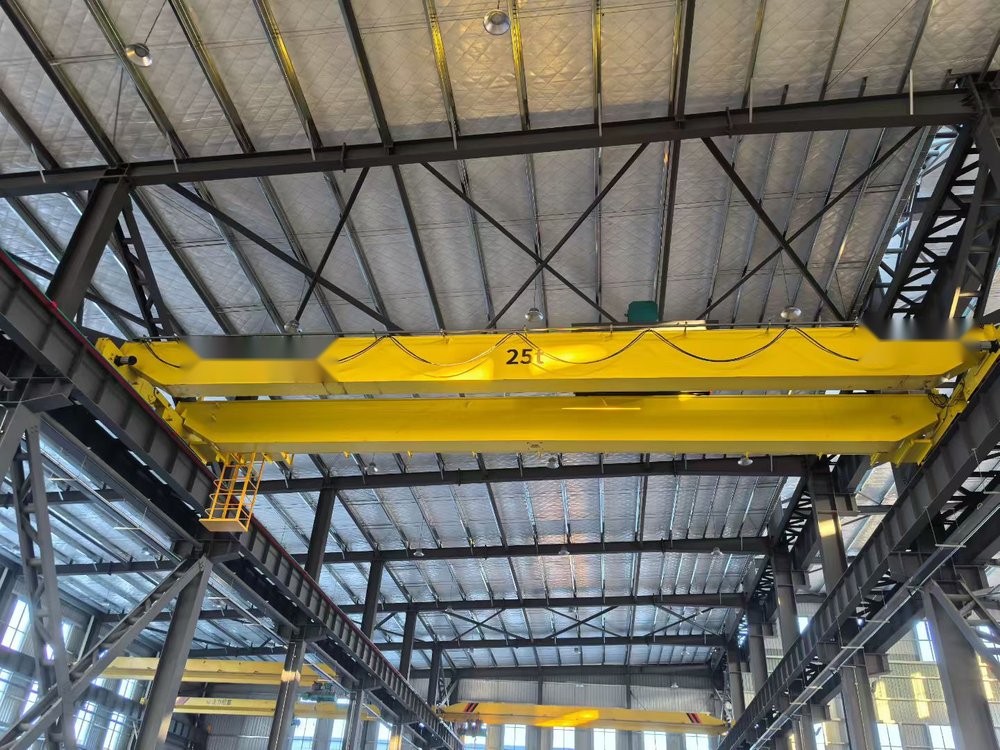
Two main girders carrying a trolley between them. Used for higher capacities, heavier duty classes and longer spans; above roughly 15 t a main + auxiliary hoist arrangement is typical (reference). The platform-on-girder layout also simplifies maintenance access.
| Parameter | Reference range * |
|---|---|
| Rated capacity | 5–80 t |
| Span | 10.5–35 m |
| Lift height | 6–18 m |
| Duty class | A5–A7 (ISO 4301 reference) |
| Hoist arrangement | Main + auxiliary above ~15 t (typical) |
| Control | Cabin / radio remote — per order |
Duty class, the number that moves your price
Two cranes of identical tonnage can differ several-fold in price because duty class — how hard and how often the crane works — changes the structure, hoist and drivetrain. We size it from your load spectrum and lifts per hour:
| Class | Typical use (reference) |
|---|---|
| A1–A2 | Standby and maintenance lifting, light infrequent use |
| A3 | Light machining and assembly, low lift frequency |
| A4–A5 | General machine shops and warehousing — the most common industrial range |
| A6–A7 | Heavy machining, foundries and metallurgy, high cycle frequency |
| A8 | Continuous heavy-duty special processes |
Configurations we build in
Options are quoted inside a locked configuration boundary — you decide what pays for itself in your operation.
- Radio remote control, pendant, or cabin control
- Variable-frequency drives (VFD) for travelling and hoisting — smooth positioning, less load swing
- Dual-speed hoisting and travelling
- Maintenance walkway, handrails and access ladders (double girder)
- Festoon system or conductor bar power supply
- Special-environment packages (dust, heat, corrosion) — assessed case by case
- Load display and overload protection per your local requirements
- Long-travel rail and runway accessories for greenfield projects
Related products & reading
Electric hoists & light systems
The lifting unit itself, plus jib cranes and transfer cars.
Light systems →Duty class & pricing FAQ
Why same-tonnage cranes differ in price, and how to lock a configuration.
Read the FAQ →Overhead crane RFQ in five numbers.
Capacity · span · lift height · duty class · power supply — quotation target within 24 h on working days.